

Refractory Anchors
Engineered with precision
Our custom anchors are designed to meet complex project specifications. Using advanced engineering principles and careful material selection, each anchor is tailored to perform reliably under extreme heat, pressure, and wear.
We also offer a full range of standard anchors that are ready to perform in industrial environments. These solutions provide dependable reliability, allowing clients to meet project deadlines without compromising quality.
Anchor Design
Initially three anchoring design systems were used in the anchorage and fastening of refractory materials:
1. Round Bar Anchors
The classic diameter round bar anchor is normally supplied to the market as a wriggled anchor and a standard opening angle of approximately 60° in stud and hand weld designs. It is used for refractory lining thicknesses up to approximately 275mm. It should be noted that with such thicknesses, this anchorage is applied in a flat position as its retaining capacity can easily be exceeded, depending on the load expected to be borne by the anchor, we also supply anchors in 5.5mm, 8mm, 10mm and 12mm diameter.
For greater installation lengths the opening angle of the anchor can be varied, in order to avoid major drifting apart of the anchor ends. This is achieved with a smaller angle of spread throughout the installed lengths or by using a smaller angle at the lower part and a greater angle at the upper part of the anchor.
2. Flat Bar Anchors
Flat bar anchors may be appropriate for small refractory material thicknesses up to around 50mm, but it should be insured that a cross-section with rounded edges is used wherever possible. The rounded edges effectively prevent cracks in the refractory material which are caused by the anchor edges.
In the past, flat bar anchors or wriggled flat bar anchors have mostly been used for heavy duty anchorages. This type of anchorage should only be regarded as an emergency measure, as it has a number of serious disadvantages. The rectangular cross-section of these anchors results in different forces having to be applied in the two main directions to bend the bar. The flat bar anchor has highly divergent resistance to movements in the refractory lining. This can result in major damage to the refractory material, as there is less stability in one direction, and in the other dir,ection the rectangular form promotes the propensity to crack, starting at the edges. In such cases, the use of round bar anchors is recommended.
Round bar anchors create a circular opening in the refractory material, which gives more stability than the rectangular hole. Flat bar anchors are to be fastened by manual welding, in most cases. Round bar anchors as an alternative can be fastened by stud welding up to a diameter of 20mm. Round bar anchors of greater diameters are available in versions of manual welding. We supply round bar anchors for heavy duty fastenings in diameters up to 12mm.
3. Twin Pin – Slotted Pin Anchors
The twin pin anchor is also easily installed by the stud welding or manual welding process. As the twin pin anchor only has to be bent out after fastening, which holds the refractory material in place, an insulating layer can easily be fitted if required. The recommendation is to use the twin pin anchors rather than slotted pin anchors because the slotted anchors often tend to break off during the bending process and therefore cannot exert the full retaining force as intended. In addition, the cut exposes the metal to a variety of attacks on its structure.
Custom Design
Apart from the anchor systems shown in this catalogue, we can supply almost any round bar anchor in a specific design. If you cannot find the anchor you need in our standard range, we will be pleased to quote you on the basis of your specification.
Selection of Anchor Alloy
The anchoring of refractory materials in addition to ceramic fasteners (anchor blocks}, predominantly metallic systems has always been used successfully. Apart from a number of special applications, the use of metallic anchorages is appropriate and the most economical solution known in the industry.
The increasing stresses placed on the refractory linings and thus on the metal anchors which support them, in the form of high temperatures, chemical attack by hot gases or on cooling below dew point, attack by aggressive aqueous solutions etc, the selection of the right anchor alloy is not always simple.
1. Stainless Steel Grade 304
304 is the most versatile and widely used of a 11 grades of stainless steel. It is suitable for use to a temperature of up to 1080°C. It’s chemical composition, mechanical properties, weldability and corrosion-oxidation resistance, provides the best all round performance stainless steel at a relative low cost.
2. Stainless Steel Grade 310
310 is a highly alloyed stainless steel used exclusively for high temperature applications. It has a higher chrome and nickel content than 304 stainless steel and is suitable for temperatures of up to 1350°C. It is resistant to oxidation (scaling} and has good high temperature strength.
3. Stainless Steel Grade 316
316 is an improved version of Grade 304, with the addition of molybdenum and a slightly higher nickel content. The resultant composition gives the steel a greatly increased corrosion resistance in chemically aggressive environments. Molybdenum makes the steel more resistant to pitting and corrosion.
Factors Affecting Anchor Performance
The following factors also have an influence on the wear performance of the anchor:
- Corrosion
- Sulphur & Sulphur compounds
- Chlorine & Chlorine compounds
- Alkalis & Alkaline earth
- Embrittlement
- Carburisation
The selection of the suitable alloy should not be based on the individual criteria, but rather on a comprehensive consideration of the all various requirements, so as to reach the right decision for the particular application.
Research indicates that the tip of an anchor buried approximately 25mm behind the lining hot face will be 150°C lower than the hot face temperature. Based on the suggested use temperatures by alloy manufacturers, the tip temperature difference and experience, the following hot face temperature for anchors are recommended:

The temperatures shown above are continuous use limits. Slightly higher temperatures may be withstood if the highest temperatures reached are cyclic in nature and below the suggested limits for most of the duration of the operation.
Anchor Depth Recommendation
It is general practice in the refractory industry for anchors to be 66% to 75% of the lining thickness, however the anchor should not extend closer than 25mm of the lining surface.
Anchor Spacing
The spacing of anchors depends on:
- The type of anchor alloy used
- The operating conditions
- The physical characteristics of the unit to be lined
The quality of anchors required varies according to the particular application and the centre to centre anchor measurement. The table as shown below gives the quantity of anchors required per square meter for various anchor spacings.

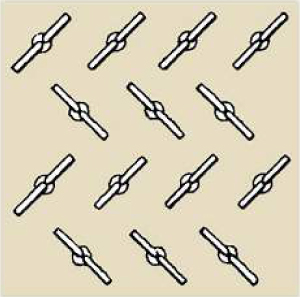
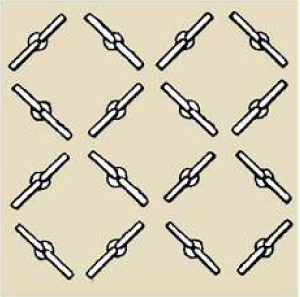
Anchor Patterns
All three of the anchorage patterns above have been successfully used. The most important fact is that an irregular pattern is achieved by opposing individual anchors. This increases the overall holding power of the anchor pattern, as well as also helping to prevent cracks from extending dangerously far in any direction or from linking together in regular networks to cause weakened areas. In order to achieve the best result, especially if studs are rectangular in base cross section, the long dimension should be welded at an angle to the vertical position as indicated.

General Comments
- It has been generally found that metal stud welded anchors used with gunned linings, low density linings, coarse aggregate materials or relatively thick linings, do not require a coating of wax, grease, tar or mastic to combat anchor expansion.
- In two-component linings, the anchor portion extending into the hot face component should develop a full ‘V’ configuration for maximum benefit.
- Various adaptations of the anchors shown in this catalogue are available on special orders for anchor into existing brick linings or into concrete shell units. Data and advice on these and other applications are available through our representative.
Bolted Refractory Anchors
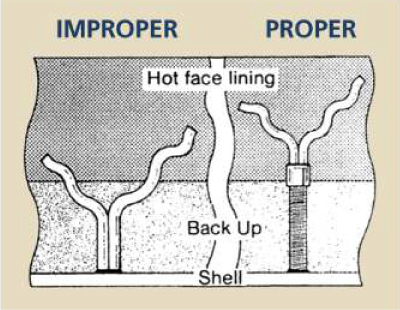
Stud welding makes a quick, inexpensive substitute for hand welding a common ‘Y’ type anchor with a bent-up shank. Hand welding around the loop or bent-up portion requires considerable time. A M1O-diameter threaded stud can be stud welded to the shell. The stud accommodates the next nut that secures the anchor. If it is desirable to make the anchor stand away from the shell a longer thread stud and double nuts may be used. Either way, positive holding power is provided, since the anchor cannot slip off the nut. In addition, careful tightening of the nut will incorporate sufficient movement into the system so that the anchor will accommodate stresses by ‘floating’.

Ready to specify your anchors or weld studs?
Oster combines engineering precision, flexible solutions, and technical expertise to deliver refractory anchors and weld studs that meet the highest industry standards.
Contact our team today to discuss your project requirements.